Understanding UV Primers: Common Types and Their Applications
In UV printing, primer is often a key factor in determining the final print quality. While many users focus on printer specifications and ink performance, different substrates also require different types of primer. Choosing the right primer can improve ink adhesion and durability while reducing problems such as peeling and flaking.

Here are several common types of UV printing primers and their typical applications.
General-Purpose Primer
General-purpose primer offers broad material compatibility and can be used on many metals, glass, ceramics, and certain rigid plastics.
Its formulation balances adhesion and drying speed, making it relatively easy to apply. The primer can usually be evenly coated and allowed to air-dry or low-temperature dry before printing.
For businesses handling a variety of materials, a general-purpose primer can be a practical option.
Glass Primer
Glass primer is specially formulated for smooth, low-surface-energy materials such as glass. Conventional primers may struggle to achieve sufficient adhesion on glass surfaces.
Glass-specific formulations improve surface wettability, allowing ink to spread evenly and bond more effectively. They are commonly used for glass artwork, decorative glass doors, and glass crafts.
Metal Primer
Metal primer focuses on adhesion, durability, and resistance to environmental conditions. Materials such as stainless steel, aluminum, and copper often require stronger adhesion, especially for outdoor or industrial applications.
A suitable metal primer helps create a stronger bonding layer between the ink and substrate, improving resistance to scratches, oxidation, and temperature changes. Typical applications include equipment nameplates, outdoor signs, and automotive interior components.
Primer for Specific Ink/Substrate Combinations
With the development of primer-free UV inks, some substrates such as acrylic, PET, and PVC can be printed without applying primer when using compatible ink systems.
However, for applications requiring higher adhesion or durability, an appropriate primer can still be used as an additional treatment to improve print performance.
Primer for Flexible Materials
Flexible substrates such as leather, silicone, and rubber can deform during use. If the primer is too rigid, it may crack or peel when the material is bent or stretched.
Flexible-material primers are formulated with greater elasticity, allowing the coating to better follow the movement of the substrate. They can be used for products such as phone cases, leather notebook covers, and silicone accessories.
Test Before Mass Production
Understanding the characteristics and applications of different primers helps operators choose the right treatment for each substrate.
In actual production, it is recommended to test the primer and ink combination on a small sample first, checking adhesion, curing, and print quality before moving into mass production. This simple step can help prevent material waste caused by an unsuitable primer or ink combination.
-

Thank You for Every Connection! Nuocai Wraps Up the Shenzhen Gifts & Home Fair Successfully — Visit Our Factory to Discover More
2026-10-23 -

Final Countdown! Day Three at the Shenzhen Gifts & Home Fair: Nuocai’s Last-Chance Show Specials Are Bigger Than Ever
2026-10-22 -

Day Two at the Shenzhen Gifts & Home Fair: Nuocai Keeps the Crowds Coming! Live Demos of 3D Figures, 2.5D Relief Crafts, Perfume Bottles, Tumblers, and UV DTF Stickers
2026-10-22 -

A Decade of Excellence: Nuocai Unveils Its Latest Innovations on Day One of the Shenzhen Gifts & Home Fair! Full-Color 3D Printing Steals the Show
2026-10-20 -

Nuocai Successfully Concludes PRINTING United Expo 2026 in Las Vegas
2026-09-28 -

Making an Impact in Las Vegas — Nuocai Makes a Strong Debut at PRINTING United Expo 2026
2026-09-24 -

Growing Together, Moving Forward with Purpose | Guangzhou Nuocai 2026 Production Trainee Representative Symposium
2026-08-29 -

A Truckload of Henan Melons, A Thousand-Mile Bond with Guangdong|Nocai’s Charitable Purchase: Supporting Farmers, Refreshing Our Team
2026-08-11 -

Topping-out Ceremony Successfully Held! NOCAI Digital’s Capital Increase & Capacity Expansion Project Officially Topped Out, Embarking on a New Journey of Smart Manufacturing
2026-04-28 -
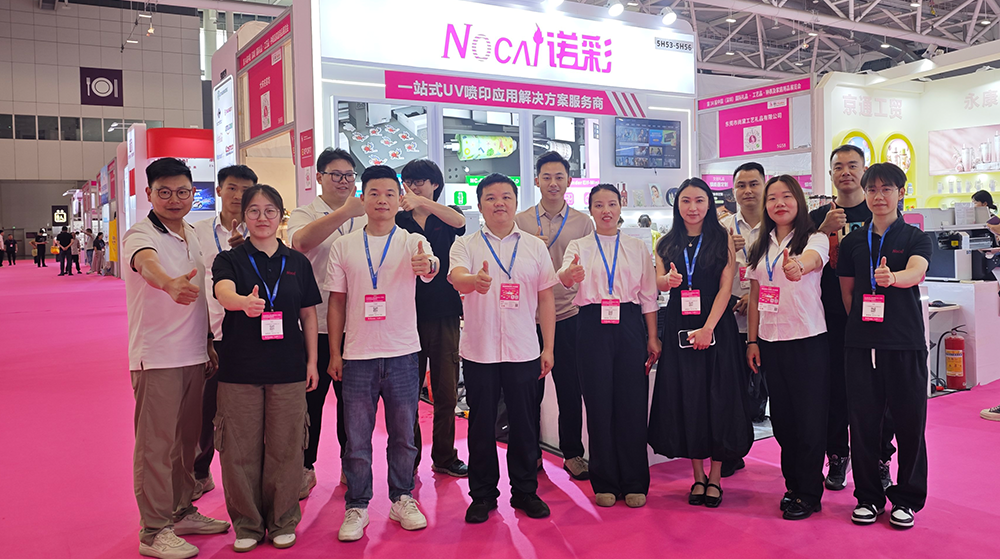
NOCAI’s Shenzhen Gift Fair Successfully Concluded. You Are Warmly Invited to Visit Our Factory for New Cooperation
2026-04-28
-

How Important Is UV Ink Concentration to Print Quality?
2026-11-17 -
Understanding UV Primers: Common Types and Their Applications
2026-11-17 -

What Can a 6090 UV Flatbed Printer Actually Do? Here’s the Full Picture
2026-11-10 -

Is Your Phone Case Artwork Always Misaligned? How Small Flatbed UV Printers Solve the Problem
2026-11-10 -

Beyond Simulated Mother of Pearl: What Other Traditional Crafts Can UV Printers Replicate?
2026-11-04 -

From Flat to Emboss: How Compact UV Printers Build Tactile Texture
2026-11-04 -

Tackling the Four Major Pain-Points of Cylindrical UV Printers: Height Variation, Cones, Special-Shaped Parts & Transparent Materials
2026-10-27 -

Simulating Mother-of-Pearl Inlay with UV Printers
2026-10-27 -

What Can a 6090 UV Flatbed Printer Produce? From Phone Cases to Metal Signs and Acrylic Artwork
2026-10-23 -
What to Do When a UV Flatbed Printer Printhead Clogs After Long-Term Inactivity?
2026-10-23
CONTACT US


Guangzhou Nuocai Digital Products Co., Ltd.
If you would like to keep touch with us directly, please go to contact us
-
![]()
Home
-
![]()
Tel
-
![]()
Email
-
![]()
Contact


